Healthy Discipline vs. Hyper-Optimisation
*A blog post from my Substack, which you can access HERE
Promoting healthy balance is far from original, but where is the line between health consciousness and wellness obsession?
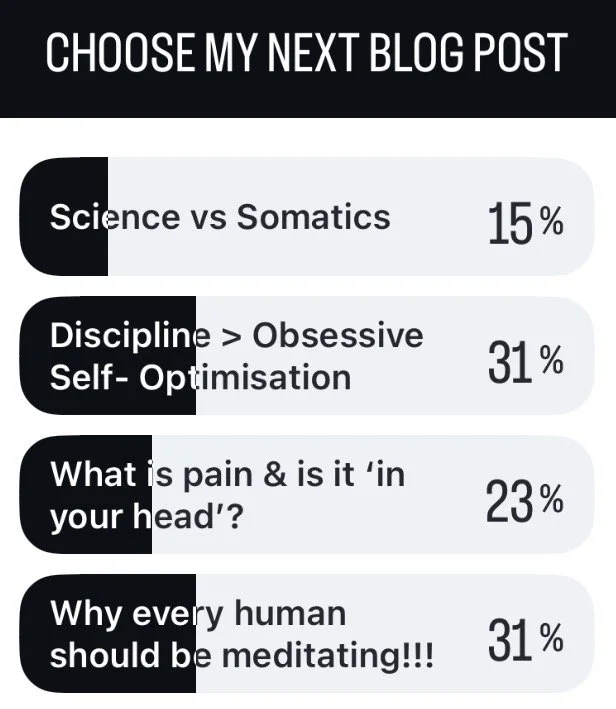
I have wanted to talk about this for so long!!! As someone who works in the wellness industry, but also as a human being figuring out how to get the most joy out of my life, I feel super passionately about this topic. I went through a period of burnout and chronic illness where I was my most “healthy” on paper but my most unwell in reality - and I started to see this pattern in the people around me as well. I was so glad when this topic was voted by you guys as my next blog.
So let’s explore: when does healthy discipline with wellness habits become obsessive self-optimisation?
Discipline vs. Optimisation vs. Obsession in the context of Wellness
While discipline is described as the practice of training yourself to follow rules and practice self-control, self-optimisation is about practices that encourage people to pursue the best imaginable version of their body, mental state and life. To me, that means that discipline is about habits whereas self-optimisation is about an outcome. They are interconnected by way of habitual discipline being required to achieve an optimal outcome.
I want to delve specifically into the self-optimisation of our health and well-being. The Global Wellness Institute (yeah, that’s apparently a thing!) defines wellness as the pursuit of activities, choices and lifestyles that lead to a state of holistic health. But if wellness is about the pursuit of holistic well-being, how do we know when we’ve reached it? Well, the good old GWI describes optimal health not as a static milestone or a perfect state of being, but as a way of life that involves proactively maximising your vitality, preventing chronic disease and enhancing your quality of life. Seems reasonable!
In that sense though, chasing wellness actually means chasing something that can’t be objectively defined. And as we will go on to discuss, I actually don’t think there’s anything inherently wrong with following a general direction with no exact destination. But pursuing something with no obvious endpoint can be a one-way ticket to a never-ending hamster wheel of constant optimisation. We can always sleep more, eat better, exercise harder, be more mindful, become happier or track another metric. There is no finish line.
So to recap: Discipline is about reliably showing up for the things that we have decided matter to us. Wellness self-optimisation is about pursuing optimal health. Obsessive hyper-optimisation is about treating our body and our life like a project that requires permanent maintenance and endless correction; a machine that must be constantly improved upon.
Extremist Culture
Apparently, evolutionary biology, psychology and social structure promote a human tendency to take things to the extreme. The underlying drive to go too far is as old as humanity itself. For this, we can thank:
The ‘Molecule of More’ (Long & Lieberman, 2018) otherwise known as dopamine, that drives us to aggressively pursue more of whatever triggers its release - regardless of whether the outcome actually satisfies or benefits us.
The brain’s desire to reduce cognitive load by developing black-and-white rules that don’t require daily decision-making (i.e. no sugar vs. sugar in moderation).
The human tendency to turn our interests or pursuits into part of our identity for the purpose of social acceptance - often tied up in the fact that we are rewarded for doing extreme things.
How extremism plays out in wellness self-optimisation is a pattern of obsession masked as “self-care”; an unconscious subscription to the “I’ll be happy when…” mentality; an endless journey of trying to achieve worthiness (without ever really arriving).
Even though extremism is a classic human tendency, the reason that this pattern feels particularly amplified these days is due to the impact of modern societal values (reward of productivity, achievement and status), modern technology (e.g., wearable health trackers), social media (hello “maxxing”), and the wellness economy’s effective fear marketing strategies (“tap water gives you cancer, our filter will fix everything”). And I want to highlight that if you do feel lost and overwhelmed by the (multi-trillion-dollar, BTW) wellness industry, it is not your fault! The industry is designed to make you feel that way and we are all here navigating the hamster wheel with you - even those of us who work in this space.
Community Poll
Last week, I asked my Instagram audience how their current wellness routine felt. Apparently the majority of you are “grinding but enjoying yourselves” with some of you feeling like you’re “chasing your tail”.
And perhaps unsurprisingly, when I asked what emotion sits underneath setting a new wellness goal or buying a new wellness product, 100% answered: “upgrading myself or my life”.
Optimisation Implications
Why do I care so much about this? Why should you care? What are the actual implications of self-optimisation culture on our health and wellbeing? I’m glad you asked! And I want to start with a study that highlights the overarching point of this article, which is that our obsessive, endless pursuit for wellness, is what is shooting our health in the foot.
Research by Zahrt & Crum in 2017 demonstrated that people’s perceptions about their level of physical activity strongly predicted their mortality rate regardless of how active they actually were. Which is to say that if you believe that you aren’t doing enough for your health, your health will suffer no matter how many health habits you’re implementing. And on the flip, it means that if you believe you are doing enough and that you are a generally healthy person, your actual health outcomes are likely to benefit.
Some research strongly suggests that our beliefs about our health habits literally matter more than the health habits themselves - our beliefs directly SHAPE our biology.
In fact, so many measures of holistic health can be negatively influenced by our own stress - including our attempts to lower stress! God, we humans can be painfully ironic.
The ‘Mind over Milkshakes’ study demonstrated that our beliefs about food (i.e. whether we think something is healthy or unhealthy) change the way our bodies process food. If we believe something is unhealthy, we have worse health outcomes - even in something as objective as our blood sugar!
2022 research on over 7,000 people across 40 countries found that societal pressure to be happy is linked to poor well-being (even more so in ‘happy’ nations!).
Even though modern wellness culture encourages us to hyper-focus on ourselves, reviews have consistently found that prosocial interventions (like acts of kindness for others) are associated with better health outcomes and ‘psychological flourishing’ compared to self-focus on our health or happiness.
The quantification of biology turns even relaxation into a data-driven metric, rather than an internal feeling (it’s f*cking weird when you think about it!).
Among the Instagram story polls was a question about whether my audience feels in tune with their body’s needs. Everyone indicated that they felt they were “sometimes” in tune or that they were “working on it”. While my Instagram followers are not necessarily a perfect representation of the average person, I found it interesting to wonder if we are actually getting better at listening to our body’s needs amidst our pursuit of optimised health.
Am I hyper-optimisation obsessed?
But how do you know when the pursuit of health becomes unhealthy? I mean, obviously, when sleep tracking is causing you insomnia, you can assume you’ve passed that invisible line, but what about the other, not-so-obviously-ironic examples? Well here are some of the signs and symptoms of obsessive hyper-optimisation that may be negatively impacting your wellbeing:
Increased physical symptoms such as fatigue and anxiety (despite doing more health protocols)
Compulsive checking of food labels, ingredients, wearable health tracking data or your own body/weight
Viewing food, exercise, rest or other habits as inherently "good" or "bad" and feelings of guilt for not optimising your health
Lack of flexibility in your life, habits and routines
Feeling as though a single deviation from your wellness routine can ruin your mood
Hyperfixation on wellness metrics and data - often coupled with a reduced ability to connect with your own body’s signals
Constant researching and chasing the next best thing, cure or habit
Severe restriction
Social withdrawal and/or strain on existing relationships
Reduced capacity for connection with others due to judgement about differences in wellness behaviours (“Omg they still eat seed oils? What losers!”)
How to build a healthier relationship with wellness
Okay so for those who saw themselves in some of the above symptoms or even just those who would like to build a healthier and more balanced relationship with wellness, here is what I can recommend for you:
Habits & Goal Setting
Develop values-based goals: Identify your personal values (e.g. health, learning, kindness) and then develop goals around those values. For example: Instead of ‘run a marathon by the end of the year’, you could identify that physical wellbeing is something you value so you want to move your body each day in some way. Or you could change ‘read 50 books this year’ to ‘I value curiosity and learning, so I will place books around the house to encourage the habit of reading more often while enjoying the process’.
Develop a minimum viable habit (MVH) within your goals. So instead of ‘train for one hour every day’ or ‘meditate for 30 mins per day’, set the goal to move or meditate daily without rigid metrics that impact enjoyment and long-term sustainability. Your MVH may be a 10-minute YouTube yoga video or a 2 minute breathwork exercise depending on your energy levels.
Implement a “Don’t Miss Twice” rule. One missed workout or meditation is not the end of the world, but if you are wanting to build discipline and self-integrity, you could promise yourself never to miss twice in a row.
“But Atomic Habits says—” I don’t caaaaaare!!! Your life is here to be lived! Make mistakes, learn from them, find sustainable balance and leave space for relationships and community. Set yourself hard challenges if it brings you genuine joy and satisfaction, but for those that feel negatively impacted by self-optimisation culture, the above tips could be your way off the wheel.
Activities
Somatic movement! This type of movement is all about how the body feels and developing the mind-body connection as opposed to how movement looks or what we’re achieving. I have a video all about Somatic movement and ways to implement it into your life which you can find here: https://www.instagram.com/p/DduiZq1BFaG/
Open Monitoring Meditation for the purpose of learning neutral acceptance. For this exercise, set a timer for 5 or 10 minutes and start with a minute or two of tuning into your breath. Then expand your awareness to check in with your bodily sensations and then expand to observing your thoughts, imagining them as clouds passing through the sky. Mentally note your thoughts, emotions or physical sensations (e.g. ‘worry’, ‘jealousy’, ‘chest tightness’) without judging, creating a story about it or intervening. Accept both positive and negative emotions. This teaches us that different emotional states are temporary and okay, leading to a reduced need to ‘improve’ everything and a greater capacity for self-acceptance.
Stop listening exclusively to self-help or self-improvement content!! Let yourself have some fun; listen to a comedy podcast, watch the goddamn rom-com.
Mindset prompts
How would you define yourself beyond your interest in wellness and health? Can you untie your sense of self or worthiness from your achievements - no matter how incredible? What kind of human being are you or do you want to be?
What habits would you have and what goals would you be setting if there were no eyes, no posting, no comparison? If you couldn’t tell a single person about your achievements, would you still be chasing them? If you wouldn’t, then your goal is likely motivated by optimisation or external validation rather than genuine intrinsic motivation.
If you didn’t change or “improve” or get fitter or skinnier or prettier ever again, could you accept yourself right now as you are? If not, some self-compassion may be in order <3
Wellness used to be a state of mind-body balance, identified by an internal feeling, as opposed to an external metric. Choosing to step off the hamster wheel of optimisation, put the Garmin to the side for a day and tell absolutely no-one about the gruelling workout you just put yourself through, is, in my opinion, a deliciously rebellious and empowering act of rejection of modern wellness capitalism.
What are your thoughts?
Love,
Mrs Beyond
————————————————————————————————————————————————————————————————-
References
Atkinson, S. (2021). The toxic effects of subjective wellbeing and potential tonics. Social Science & Medicine, 288, 113098. https://doi.org/10.1016/j.socscimed.2020.113098
Cambridge University Press. (n.d.). Discipline. In Cambridge Dictionary. https://dictionary.cambridge.org/dictionary/english/discipline
Chater, N. (1999). The search for simplicity: A fundamental cognitive principle? The Quarterly Journal of Experimental Psychology Section A, 52(2), 273–302. https://doi.org/10.1080/713755819
Crum, A. J., Corbin, W. R., Brownell, K. D., & Salovey, P. (2011). Mind over milkshakes: Mindsets, not just nutrients, determine ghrelin response. Health Psychology, 30(4), 424–429. https://doi.org/10.1037/a0023467
Deutsche Gesetzliche Unfallversicherung. (2025). Selbstoptimierung. Institut für Arbeitsschutz der Deutschen Gesetzlichen Unfallversicherung. https://dguv.de/ifa/fachinfos/arbeiten-4-0/risikoobservatorium/trendportal/selbstoptimierung.jsp
Dejonckheere, E., Rhee, J. J., Baguma, P. K., & Kuppens, P. (2022). Perceiving societal pressure to be happy is linked to poor well-being, especially in happy nations. Scientific Reports, 12, 1514. https://doi.org/10.1038/s41598-021-04262-z
Global Wellness Institute. (n.d.). What is wellness? https://globalwellnessinstitute.org/what-is-wellness/
Mor, N., & Winquist, J. (2002). Self-focused attention and negative affect: A meta-analysis. Psychological Bulletin, 128(4), 638–662. https://doi.org/10.1037/0033-2909.128.4.638
Moseley, J. B., O’Malley, K., Petersen, N. J., Menke, T. J., Brody, B. A., Kuykendall, D. H., Hollingsworth, J. C., Ashton, C. M., & Wray, N. P. (2002). A controlled trial of arthroscopic surgery for osteoarthritis of the knee. New England Journal of Medicine, 347(2), 81–88. https://doi.org/10.1056/NEJMoa013259
Nelson, S. K., Layous, K., Cole, S. W., & Lyubomirsky, S. (2016). Do unto others or treat yourself? The effects of prosocial behavior and self-focused behavior on psychological flourishing. Emotion, 16(6), 850–861. https://doi.org/10.1037/emo0000178
Nehring, D., & Röcke, A. (2024). Self-optimisation: Conceptual, discursive and historical perspectives. Current Sociology, 72(6), 1069–1087. https://doi.org/10.1177/00113921221146575
Zahrt, O. H., & Crum, A. J. (2017). Perceived physical activity and mortality: Evidence from three nationally representative U.S. samples. Health Psychology, 36(11), 1017–1025. https://doi.org/10.1037/hea0000531
Byrne, M., Tan, R. K. J., Wu, D., Marley, G., Hlatshwako, T. G., Tao, Y., Bissram, J., Nachman, S., Tang, W., Ramaswamy, R., & Tucker, J. D. (2023). Prosocial interventions and health outcomes: A systematic review and meta-analysis. JAMA Network Open, 6(12), e2346789. https://doi.org/10.1001/jamanetworkopen.2023.46789
HomeDoc. (n.d.). The dopamine trap: Why your brain keeps chasing what it doesn’t have. https://homedoc.com.au/blog/the-dopamine-trap-why-your-brain-keeps-chasing-what-it-doesnt-hav